The Three Giants Dominating the Cloud Market
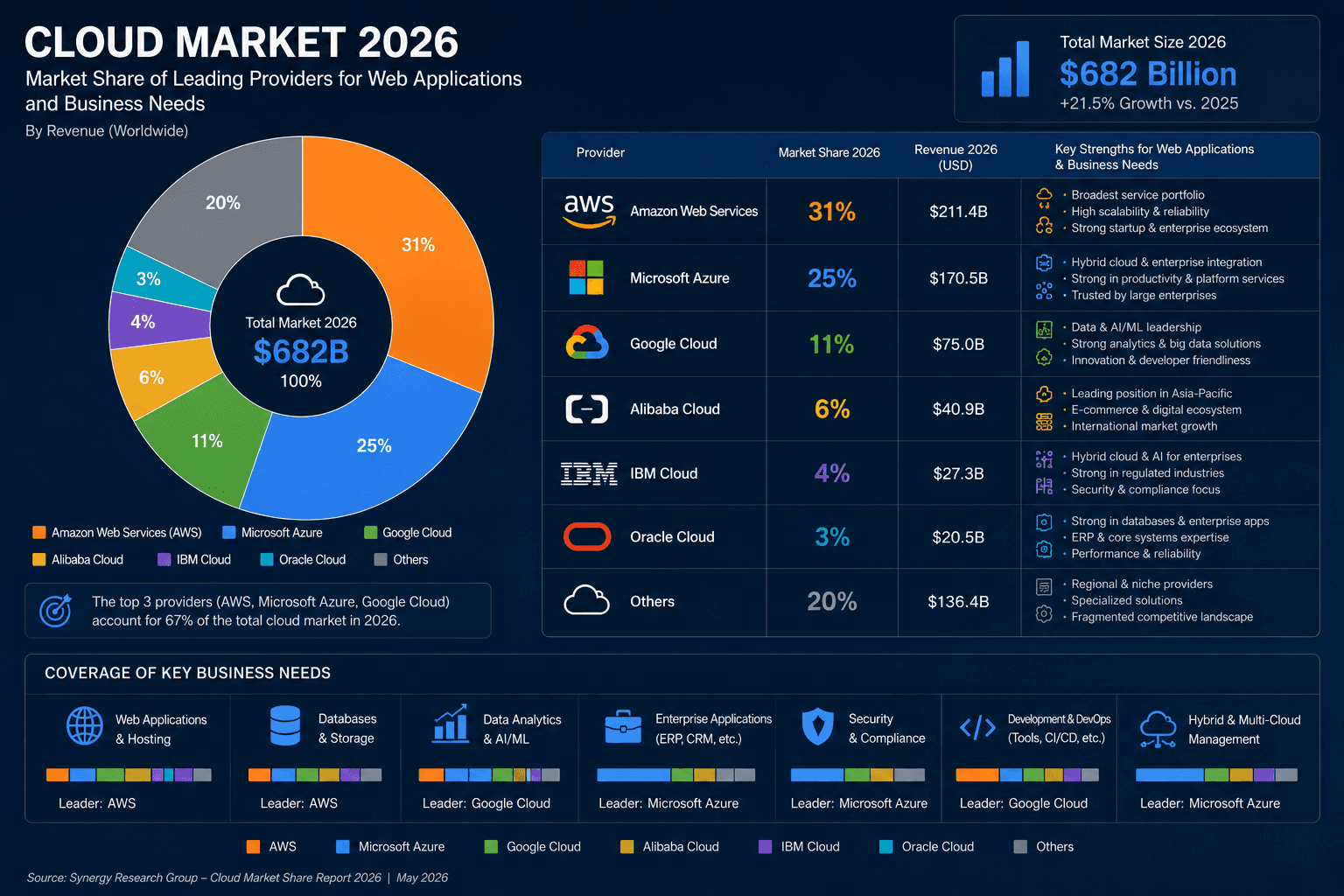
The global cloud market is largely shaped by three major providers: Amazon Web Services (AWS), Microsoft Azure, and Google Cloud Platform (GCP). Together, they dominate the industry and continue to compete through innovation, infrastructure expansion, and AI investments.
Amazon Web Services (AWS) remains the market leader, with an estimated market share of around 31%. Its success is built on scalability, reliability, and a massive ecosystem of cloud services. From startups to multinational corporations, millions of applications rely on AWS for hosting, storage, networking, and cloud-native infrastructure.
Microsoft Azure follows with approximately 25% market share. Its strongest advantage lies in enterprise integration, particularly through Microsoft 365, Windows Server, Active Directory, and hybrid cloud solutions. Azure has also strengthened its position through significant investments in artificial intelligence and enterprise AI services.
Google Cloud holds approximately 11% of the market and continues to expand its position in artificial intelligence, machine learning, Kubernetes, and data analytics. Technologies such as BigQuery and Vertex AI make it particularly attractive to AI startups, data engineers, and organizations building modern cloud-native applications.
Artificial Intelligence Is Reshaping Cloud Computing
One of the biggest developments in 2026 is the growing demand for AI infrastructure. Cloud providers are investing billions in GPU clusters, specialized AI chips, large language models, and high-performance computing systems. The cloud is gradually becoming the foundation of the global AI economy. Companies need enormous computing resources to train models, process large datasets, and deploy intelligent automation systems. As a result, competition between cloud providers is increasingly determined by their ability to deliver powerful, scalable, and cost-efficient AI infrastructure.
Multi-Cloud and Cloud-Native Engineering
Another important trend is the growing adoption of multi-cloud and hybrid-cloud strategies. Large organizations are increasingly combining AWS, Azure, and Google Cloud to improve reliability, optimize infrastructure costs, and reduce dependency on individual providers. At the same time, Kubernetes, containers, microservices, and Infrastructure as Code have transformed modern software development. Instead of relying on traditional monolithic applications, engineering teams are building distributed systems that can scale automatically and operate across multiple environments. This shift is increasing demand for cloud architects, DevOps engineers, platform engineers, and Site Reliability Engineers (SREs).
Security and the Future of Cloud Infrastructure
As more critical systems move into the cloud, cybersecurity has become a central priority. Cloud providers are investing heavily in zero-trust architectures, encryption, identity management, automated threat detection, and regulatory compliance. Looking ahead, the next generation of cloud computing will be shaped by AI-native infrastructure, autonomous cloud operations, edge computing, and energy-efficient data centers. These technologies will play an increasingly important role in supporting the global digital economy.
Conclusion: Cloud Computing Is the Foundation of the AI Era
The cloud computing market in 2026 represents much more than servers, storage, and networking. It is the infrastructure powering artificial intelligence, enterprise transformation, modern software engineering, and global digital innovation. AWS, Microsoft Azure, and Google Cloud will remain central players in this transformation. However, their competition will increasingly focus on AI capabilities, infrastructure efficiency, security, and developer ecosystems.
For software engineers, cloud architects, technology leaders, and businesses, understanding cloud computing is no longer optional. It has become a fundamental requirement for building and operating the next generation of digital systems.