Relational Databases vs. NoSQL: Understanding the Differences, Strengths, and Best Use Cases
Choosing the right database is one of the most important architectural decisions when developing modern software applications. The database influences application performance, scalability, data consistency, maintainability, and the overall system architecture. Two technologies frequently considered by software engineers are PostgreSQL and MongoDB. Both are powerful database systems, but they follow fundamentally different approaches to storing, organizing, and processing information. PostgreSQL represents the relational database model, while MongoDB follows a document-oriented NoSQL approach. Understanding their differences is essential when designing scalable backend systems, enterprise applications, and distributed architectures.
1. PostgreSQL: The Power of Relational Database Architecture
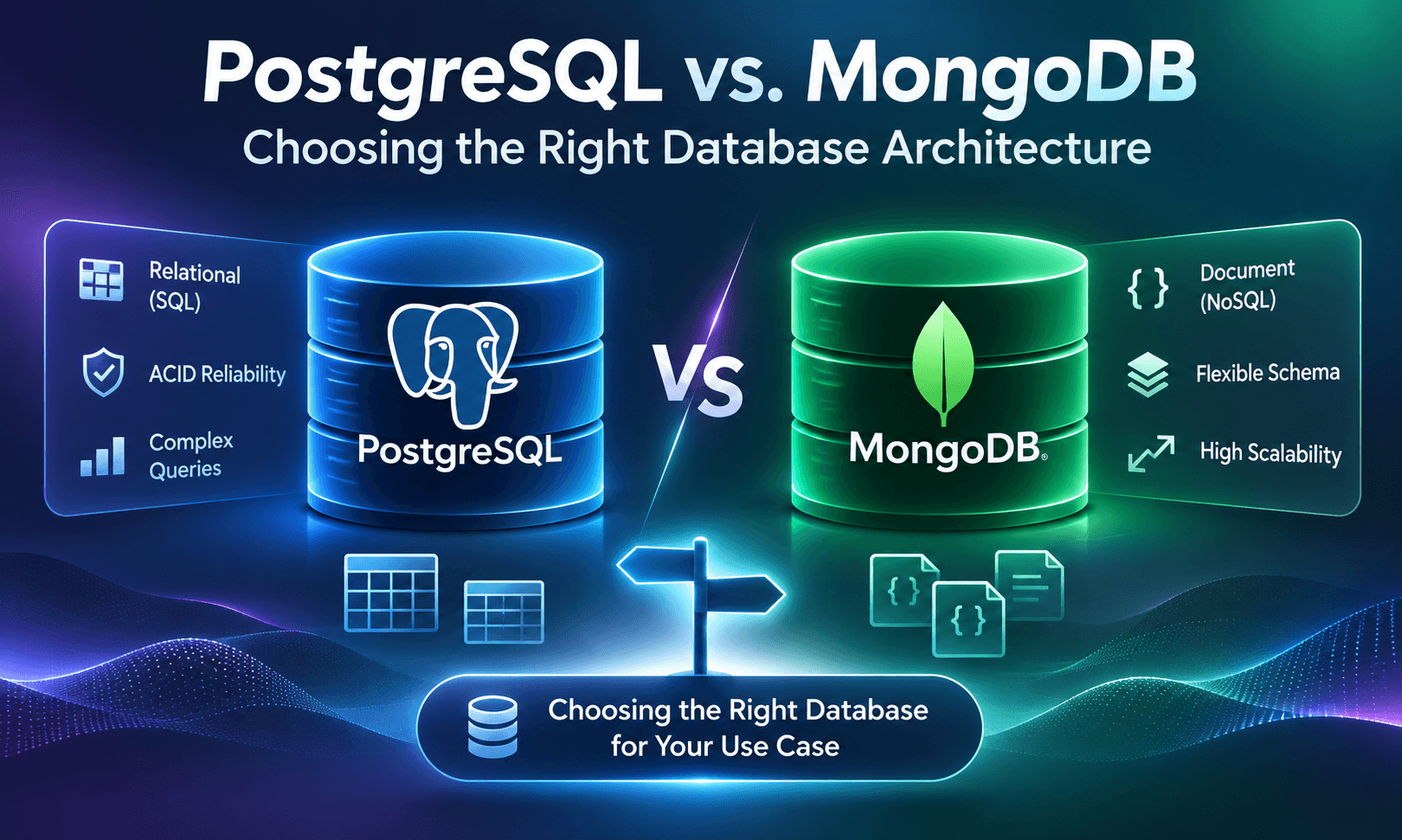
PostgreSQL is one of the most established open-source relational database management systems. It is widely used in enterprise applications, financial systems, SaaS platforms, and complex backend architectures where data consistency and transactional reliability are essential. As a relational database, PostgreSQL organizes information into tables consisting of rows and columns. Relationships between different entities are established through primary keys, foreign keys, and SQL queries. This structure makes it particularly suitable for applications with clearly defined data models and complex relationships. One of PostgreSQL’s greatest strengths is its support for ACID transactions, ensuring atomicity, consistency, isolation, and durability. These properties are especially important in applications involving financial transactions, inventory management, payment processing, and other operations where data integrity is critical. PostgreSQL also provides advanced indexing, sophisticated query optimization, replication, partitioning, and support for complex analytical queries. Additionally, its JSONB functionality allows developers to store and query semi-structured JSON data without abandoning the relational database architecture. This combination of relational consistency and flexible data handling makes PostgreSQL an extremely versatile database solution.
2. MongoDB: Flexibility Through Document-Oriented Architecture
MongoDB takes a different approach to data management. Instead of organizing information into traditional relational tables, MongoDB stores data as BSON documents within collections. These documents can contain nested objects, arrays, and dynamically structured fields. This provides developers with considerable flexibility when working with data models that evolve frequently or contain different structures. For example, an e-commerce application might store customer information, addresses, preferences, and order-related metadata within a document structure. Developers can modify document fields without necessarily requiring traditional relational schema migrations. MongoDB is particularly attractive for applications involving large volumes of semi-structured data, content management systems, product catalogs, event data, and certain real-time applications. Another important capability is horizontal scaling through sharding, which allows data to be distributed across multiple database servers. Combined with replica sets, MongoDB provides mechanisms for high availability and distributed data management. However, flexible schemas do not eliminate the need for data modeling. Poorly designed document structures can introduce duplication, consistency problems, and inefficient queries.
3. PostgreSQL vs. MongoDB: The Key Architectural Differences
The fundamental difference between PostgreSQL and MongoDB lies in their data models and how applications interact with stored information. PostgreSQL is particularly effective when applications require structured relationships, complex joins, transactional integrity, and sophisticated SQL queries. MongoDB is often advantageous when working with document-oriented data structures, evolving schemas, and application models that naturally map to JSON-like documents. Performance depends heavily on the workload, indexing strategy, data model, query patterns, and infrastructure configuration. Neither database is universally faster than the other. Similarly, both systems support replication and distributed deployment strategies, although their architectural approaches differ. An important consideration is that PostgreSQL is not limited to rigid relational data. Its JSONB capabilities allow developers to combine structured relational models with flexible document-like data. Conversely, MongoDB supports transactions, including multi-document ACID transactions. The distinction is therefore not simply about whether a database supports flexibility or consistency, but how these capabilities are implemented and used within an application.
4. When Should Developers Choose PostgreSQL?
PostgreSQL is generally an excellent choice when an application depends on complex relationships, transactional consistency, and structured data management. Financial platforms, banking applications, ERP systems, enterprise software, inventory management systems, and complex SaaS applications frequently benefit from its relational architecture. It is also an excellent option for backend applications where multiple entities are connected through relationships and where data integrity must be enforced at the database level. For many modern applications, PostgreSQL offers a particularly attractive combination of reliability, flexibility, performance, and operational maturity.
5. When Should Developers Choose MongoDB?
MongoDB can be a strong choice when application data naturally fits a document-oriented structure and flexibility is an important architectural requirement. Content management platforms, product catalogs, event-driven applications, user-generated content systems, and applications handling heterogeneous data structures can benefit from its document model. It can also be useful when application requirements evolve rapidly and developers need to accommodate different document structures. However, choosing MongoDB simply because an application requires scalability is not sufficient justification. PostgreSQL also supports sophisticated scaling strategies, replication, partitioning, and high-performance deployments. The correct decision should always be based on actual application requirements and expected access patterns.
6. Can PostgreSQL and MongoDB Be Used Together?
Interestingly, modern software architectures do not necessarily require organizations to choose only one database technology. Some systems use PostgreSQL for transactional operations and relational data while using MongoDB for document-oriented workloads. For example, an enterprise application might manage customers, payments, and financial transactions in PostgreSQL while storing flexible content, application events, or specialized document data in MongoDB. This approach is sometimes described as polyglot persistence, where different database technologies are selected according to the specific requirements of individual application components. However, operating multiple database systems introduces additional complexity involving infrastructure management, data synchronization, monitoring, backups, and consistency. Therefore, introducing a second database should solve a concrete architectural problem rather than simply increase technological complexity.
7. Conclusion: Choosing the Right Database Is an Architectural Decision
PostgreSQL and MongoDB are both powerful database technologies, but they solve different architectural challenges. PostgreSQL excels in relational data management, transactional integrity, complex queries, and applications requiring strong consistency guarantees. MongoDB provides a flexible document-oriented model that can be particularly effective for applications involving evolving data structures and document-based access patterns. Neither technology is universally superior. The right choice depends on the application’s data model, business requirements, transaction patterns, scalability expectations, and operational constraints. For software engineers and system architects, understanding these differences is essential when designing reliable and maintainable backend systems. Ultimately, the best database is not necessarily the one with the most features or the highest benchmark performance. It is the one whose architecture best matches the requirements of the system being built.