From AI-Assisted Coding to Autonomous Software Development
Software engineering is entering a new technological era. Artificial intelligence is rapidly evolving from a simple coding assistant into something far more powerful: autonomous AI agents capable of understanding codebases, modifying files, executing commands, debugging applications, and implementing entire software features. For years, developers primarily used AI tools to generate code snippets, explain programming concepts, or suggest improvements. Today, AI coding agents are changing this relationship. Instead of simply responding to individual instructions, they can analyze complex development tasks, plan implementation strategies, interact with development environments, and execute multi-step workflows. This transformation raises an important question: Are AI coding agents fundamentally changing software engineering, and what will the role of human developers look like in the future?
1. From Code Completion to Autonomous Coding Agents
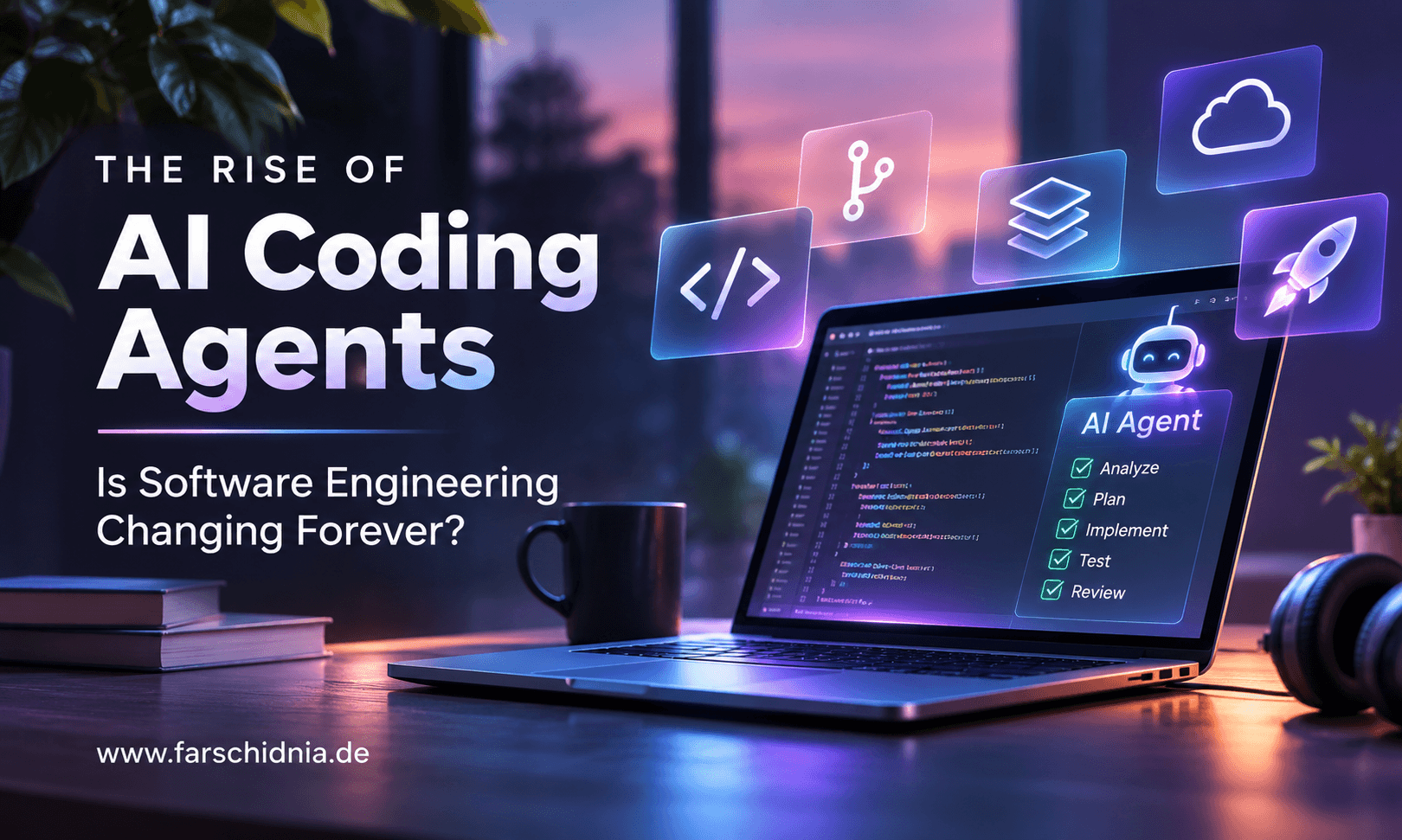
The first generation of AI-powered development tools focused primarily on code completion and intelligent suggestions. Tools such as GitHub Copilot helped developers write code faster by predicting the next lines of code and generating functions based on natural language instructions. However, the latest generation of AI coding agents operates at a different level. Rather than assisting with individual lines of code, these systems can work across entire software projects. They can inspect repositories, understand dependencies, identify potential bugs, modify multiple files, execute tests, and propose complete implementations. This represents a fundamental shift from AI-assisted programming toward agentic software development. An AI coding agent typically follows a workflow involving task analysis, planning, execution, testing, and iterative improvement. It can use development tools, interact with terminals, inspect documentation, and modify source code according to a defined objective. Instead of asking an AI to write a function, developers can now describe a feature and delegate much of the implementation process. The AI becomes an active participant in the development workflow rather than simply a tool for generating code.
2. The New Generation of AI Coding Tools
Several technology companies are competing to build increasingly capable AI development environments. Tools such as GitHub Copilot, Claude Code, Cursor, OpenAI Codex, and Google Gemini CLI represent different approaches to AI-powered software development. Some focus on integrating AI directly into traditional IDE environments, while others provide autonomous agents that operate through terminals, repositories, and development workflows. Their capabilities increasingly include understanding large codebases, implementing features across multiple files, refactoring existing systems, generating tests, and assisting with debugging. One particularly important development is the integration of AI agents into existing software engineering infrastructure. Modern agents can interact with Git repositories, development environments, CI/CD pipelines, and testing frameworks. This creates opportunities for partially automated software delivery processes. The objective is no longer simply to generate code faster. It is to automate increasingly large parts of the software development lifecycle.
3. How AI Agents Are Changing the Software Development Lifecycle
Traditional software development involves several stages: requirements analysis, system design, implementation, testing, deployment, and maintenance. Historically, developers have been responsible for managing most of these activities manually. AI coding agents are beginning to change this model. During implementation, agents can translate natural language requirements into code. During testing, they can generate test cases, execute automated test suites, and investigate failures. During maintenance, they can analyze existing codebases, identify outdated dependencies, and propose refactoring strategies. Consider a relatively common development task: implementing a new authentication feature in an existing backend application. A traditional workflow might require a developer to inspect the architecture, understand the authentication mechanism, modify several services, update database models, implement API endpoints, and write tests. An AI coding agent can assist with many of these steps, potentially executing a substantial portion of the implementation independently. However, this does not eliminate the need for engineering knowledge. The developer must still evaluate architectural decisions, validate security requirements, review generated code, and ensure that the implementation satisfies the actual business requirements. AI can accelerate execution, but engineering responsibility remains with the people building and maintaining the system.
4. The Biggest Challenge: Software Architecture and Engineering Judgment
Writing code has always been only one part of software engineering. The more difficult challenges often involve understanding complex requirements, designing scalable architectures, managing dependencies, ensuring data consistency, and building reliable distributed systems. AI coding agents are becoming increasingly capable of implementing individual features, but producing reliable production software requires much more than generating syntactically correct code. For example, an AI agent might successfully implement a REST API while overlooking architectural problems involving database transactions, authorization, concurrency, or system scalability. Similarly, generated code may work in a development environment but fail under production workloads. This is why software architecture, system design, security engineering, and code review are becoming even more important. As AI reduces the time required for implementation, the ability to evaluate technical decisions becomes a more valuable engineering skill. The future software engineer may spend less time writing repetitive code and more time defining system requirements, designing architectures, supervising AI agents, and validating complex implementations.
5. Will AI Replace Software Developers?
One of the most controversial questions surrounding AI coding agents is whether they will eventually replace software engineers. The answer is more complicated than a simple yes or no. AI will undoubtedly automate many programming tasks. Boilerplate code, repetitive implementations, basic CRUD operations, documentation generation, and certain testing activities are increasingly suitable for automation. This could significantly change the demand for particular development skills, especially in areas where work consists primarily of predictable implementation tasks. However, software engineering involves responsibilities that extend far beyond programming syntax. Understanding business requirements, making architectural trade-offs, managing technical debt, evaluating security risks, and ensuring system reliability require broader engineering judgment. Furthermore, software systems operate within organizational, economic, regulatory, and operational environments that AI agents cannot independently understand in every situation. The more realistic scenario is a transformation of the developer’s role rather than the complete disappearance of software engineers. Developers who understand how to use AI effectively, evaluate its output, and integrate autonomous agents into engineering workflows may become significantly more productive. At the same time, engineers who rely exclusively on generating code without understanding the underlying systems may find themselves increasingly disadvantaged.
6. The Emergence of Agentic Software Engineering
A particularly interesting development is the emergence of agentic software engineering. In this model, multiple AI agents can collaborate on different aspects of a software project. One agent might analyze requirements, another could implement backend functionality, while additional agents handle testing, documentation, or code review. These agents can potentially operate in parallel, reducing the time required for complex development tasks. However, coordinating multiple agents introduces new engineering challenges. Developers must manage shared context, conflicting code modifications, dependency management, execution permissions, and validation processes. There are also important security considerations. An autonomous agent with access to terminals, repositories, databases, or deployment infrastructure must operate within clearly defined permissions. This makes sandboxing, human approval mechanisms, auditability, and controlled execution essential components of reliable agentic development environments. The future of software engineering may therefore involve managing intelligent systems that collaborate with developers and with one another.
7. The New Skills Software Engineers Need
As AI coding agents become more integrated into development workflows, the skills required to become an effective software engineer will continue to evolve. Programming languages will remain important, but understanding system architecture, databases, networking, distributed computing, cloud infrastructure, and cybersecurity will become increasingly valuable. Developers will also need to understand how to work effectively with AI agents. This includes defining precise tasks, providing relevant context, designing validation workflows, reviewing generated implementations, and identifying situations where autonomous execution is inappropriate. In particular, knowledge of testing strategies and software architecture will be critical. AI can generate large amounts of code, but generating maintainable, secure, and reliable software requires engineering discipline. The most effective developers will likely be those who combine traditional engineering fundamentals with the ability to orchestrate AI-powered development workflows.
8. Conclusion: Software Engineering Is Changing, Not Disappearing
AI coding agents represent one of the most significant developments in modern software engineering. The transition from simple code completion to autonomous development workflows is changing how applications are designed, implemented, tested, and maintained. For developers, this transformation creates both opportunities and challenges. Routine programming activities will increasingly become automated, while architectural thinking, system design, security, debugging, and engineering judgment will remain essential. The software engineer of the future may not spend most of the working day manually writing code. Instead, the role may increasingly involve designing systems, defining technical requirements, orchestrating AI agents, reviewing implementations, and ensuring the reliability of complex software platforms. Ultimately, AI does not eliminate the need for software engineering. It changes the relationship between human intelligence, programming, and computational systems. The biggest competitive advantage in the future may not be how much code a developer can write, but how effectively they can design, understand, and control the systems that produce it.