Understanding the Differences Between REST and GraphQL for Modern Backend Development
APIs are the backbone of modern software architecture. They enable applications, services, and distributed systems to communicate and exchange data. Whether building a mobile application, a SaaS platform, or a large enterprise system, choosing the right API architecture has a significant impact on performance, scalability, maintainability, and developer experience. Two of the most widely used approaches are REST and GraphQL. While both solve the problem of communication between applications, they follow fundamentally different architectural principles. Understanding their strengths, limitations, and use cases is essential for modern software engineers.
1. REST API: The Foundation of Modern Web Services
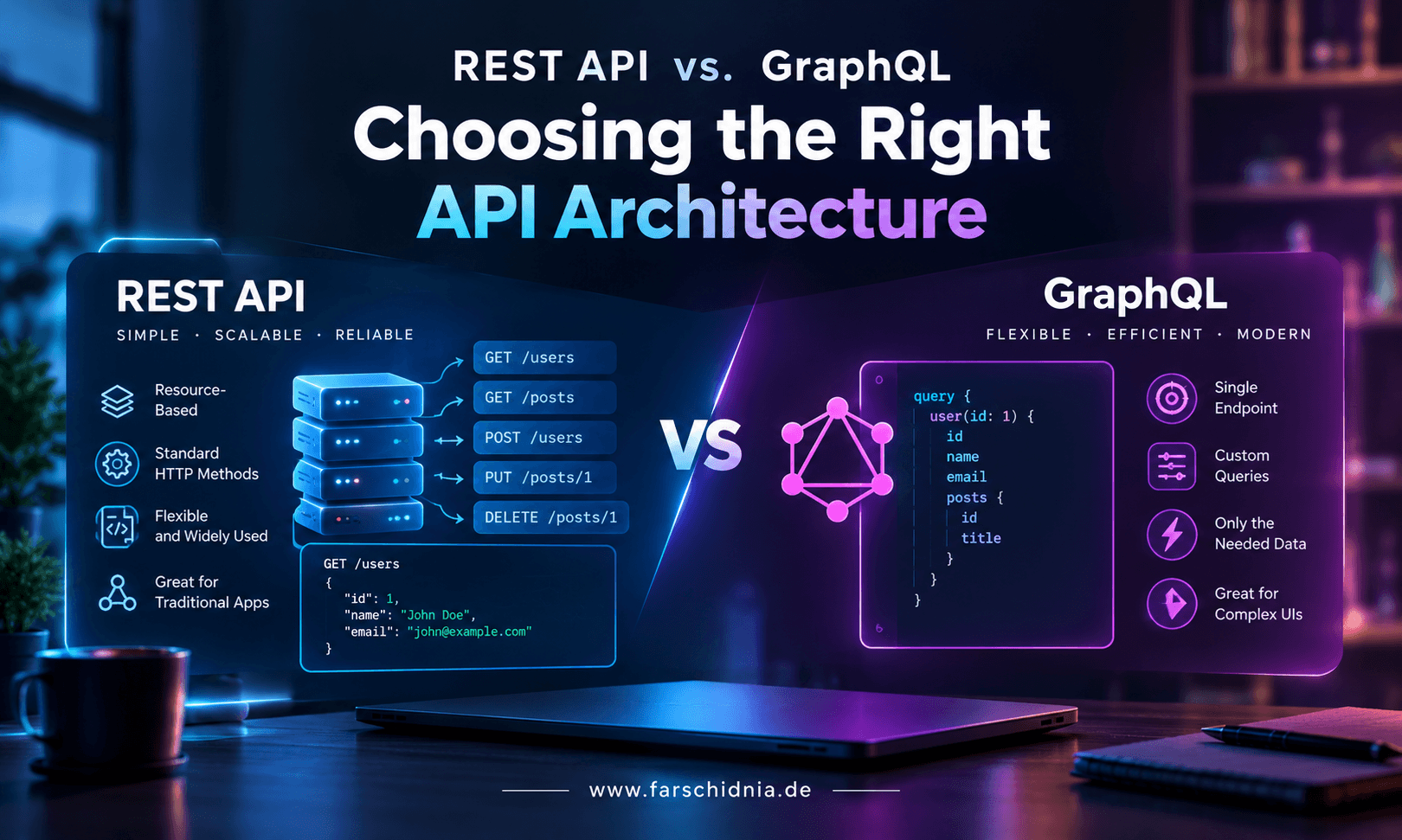
REST (Representational State Transfer) is an architectural style introduced by Roy Fielding in his doctoral dissertation in 2000. It became one of the most widely adopted approaches for building web APIs because of its simplicity, scalability, and compatibility with HTTP. REST APIs organize application functionality around resources. Each resource is typically accessible through a dedicated endpoint, and standard HTTP methods define the operations that can be performed. For example, an application managing users and products might expose endpoints such as /users, /users/123, /products, and /orders. Developers use HTTP methods such as GET, POST, PUT, PATCH, and DELETE to retrieve, create, update, and remove resources. One of REST’s biggest advantages is its simplicity. Its architecture is relatively easy to understand, implement, test, and maintain. REST also benefits from HTTP caching mechanisms, established security practices, and widespread tooling support. For many applications, REST remains an excellent choice, particularly when resources have clearly defined structures and API operations are relatively predictable.
2. GraphQL: A More Flexible Approach to Data Fetching
GraphQL was developed by Facebook and introduced publicly in 2015. Unlike REST, which typically exposes multiple resource-based endpoints, GraphQL generally provides a single endpoint through which clients can request precisely the data they need. The central idea behind GraphQL is to give clients greater control over data retrieval. Instead of receiving a predefined response from an API endpoint, clients describe the exact structure of the information they require. For example, a mobile application might need only a user’s name and email address, while a web application requires the user’s profile, orders, and account settings. With REST, these requirements may involve multiple requests or additional backend logic. GraphQL allows clients to request related information within a single query. GraphQL also introduces a strongly typed schema that defines available data types, relationships, queries, and mutations. This schema provides a clear contract between frontend and backend systems and enables powerful developer tooling. Its flexibility makes GraphQL particularly attractive for applications with complex data requirements, multiple frontend clients, and rapidly evolving user interfaces.
3. REST vs. GraphQL: The Key Architectural Differences
The fundamental difference between REST and GraphQL lies in how data is requested and delivered. REST uses resource-oriented endpoints with predefined response structures, whereas GraphQL allows clients to specify the exact data they need through structured queries. This difference has important consequences for application architecture. REST can sometimes lead to over-fetching, where an API returns more information than the client actually requires. It can also result in under-fetching, where multiple API requests are necessary to retrieve related information. GraphQL addresses these problems by allowing clients to request multiple related data structures in a single query. However, GraphQL introduces additional complexity. Developers must manage schemas, resolvers, query execution, authorization, and query performance. Poorly designed GraphQL queries can also create problems such as the N+1 query issue, where resolving nested data triggers excessive database requests. REST, on the other hand, benefits from straightforward HTTP caching, predictable endpoints, and relatively simple operational requirements. Neither architecture is universally superior. The appropriate choice depends on the application’s requirements, data structures, and expected usage patterns.
4. Performance, Caching, and Scalability
Performance is one of the most important considerations when selecting an API architecture. REST benefits from standard HTTP caching mechanisms. GET requests can be cached at different infrastructure layers, including browsers, proxies, and content delivery networks. This can significantly reduce backend workload and improve response times. GraphQL caching requires a somewhat different approach because many queries are sent to a single endpoint, often using POST requests. Although caching is possible through persisted queries, normalized client-side caches, and other strategies, it generally requires additional architectural consideration. Scalability also depends on more than the API technology itself. Database optimization, application architecture, load balancing, caching strategies, and infrastructure design often have a much greater impact on overall system performance. GraphQL offers flexibility in data retrieval, but unrestricted queries can create expensive workloads. Production systems therefore need appropriate query complexity limits, depth restrictions, pagination, and monitoring. REST offers more predictable resource boundaries, which can simplify performance optimization and operational management.
5. When Should Developers Choose REST?
REST is generally an excellent choice for applications with clearly defined resources, predictable operations, and straightforward communication requirements. Traditional enterprise applications, payment services, authentication systems, public APIs, and microservices frequently benefit from REST architecture. Its simplicity, HTTP compatibility, caching capabilities, and mature ecosystem make it particularly suitable for backend systems that prioritize stability and maintainability. For many projects, REST provides everything necessary without introducing additional architectural complexity.
6. When Should Developers Choose GraphQL?
GraphQL becomes particularly attractive when applications have complex data relationships and different clients require different combinations of information. Consider a modern SaaS platform with web applications, mobile applications, administrative dashboards, and external integrations. Each client may require different data structures and relationships. GraphQL allows these clients to retrieve the information they need without requiring developers to create numerous specialized REST endpoints. It can also simplify frontend development by providing a strongly typed API schema and flexible data-fetching capabilities. However, developers should carefully consider authorization, query complexity, caching, monitoring, and backend performance before adopting GraphQL in production environments.
7. Can REST and GraphQL Work Together?
An important architectural consideration is that REST and GraphQL are not mutually exclusive technologies. Many organizations use both approaches within the same software ecosystem. For example, a backend might expose REST endpoints for authentication, payments, and external integrations while providing a GraphQL interface for complex application data. GraphQL can also act as an abstraction layer over existing REST services, databases, and microservices. This approach allows organizations to introduce GraphQL without completely replacing their existing API infrastructure. However, combining multiple API architectures also introduces additional maintenance and operational complexity. The decision should therefore be based on concrete technical requirements rather than adopting technologies simply because they are available.
8. Conclusion: Choosing the Right API Architecture
REST and GraphQL represent two different approaches to designing modern APIs. REST provides a simple, resource-oriented architecture built around established HTTP principles. GraphQL offers greater flexibility by allowing clients to define exactly which data they need. For applications with predictable resource structures and straightforward communication patterns, REST remains a reliable and effective solution. For applications with complex data relationships, multiple frontend clients, and dynamic data requirements, GraphQL can provide significant advantages. Ultimately, choosing the right API architecture requires understanding the application’s requirements, performance expectations, security considerations, and long-term maintenance strategy. Good API architecture is not about choosing the newest technology. It is about selecting the right communication model for the system you are building.