Spec-Driven Development
Software development begins with understanding a problem. Before choosing a framework, designing a database, or writing a function, a team needs to agree on what the software should accomplish.
That agreement is often less complete than it appears. A request such as “add user registration” sounds straightforward, but it leaves many decisions open. Must users verify their email address? Can they register twice? What happens when verification expires? Which information is required?
When these questions remain unanswered, developers make assumptions. Those assumptions become code, and the differences usually appear during testing or after release.
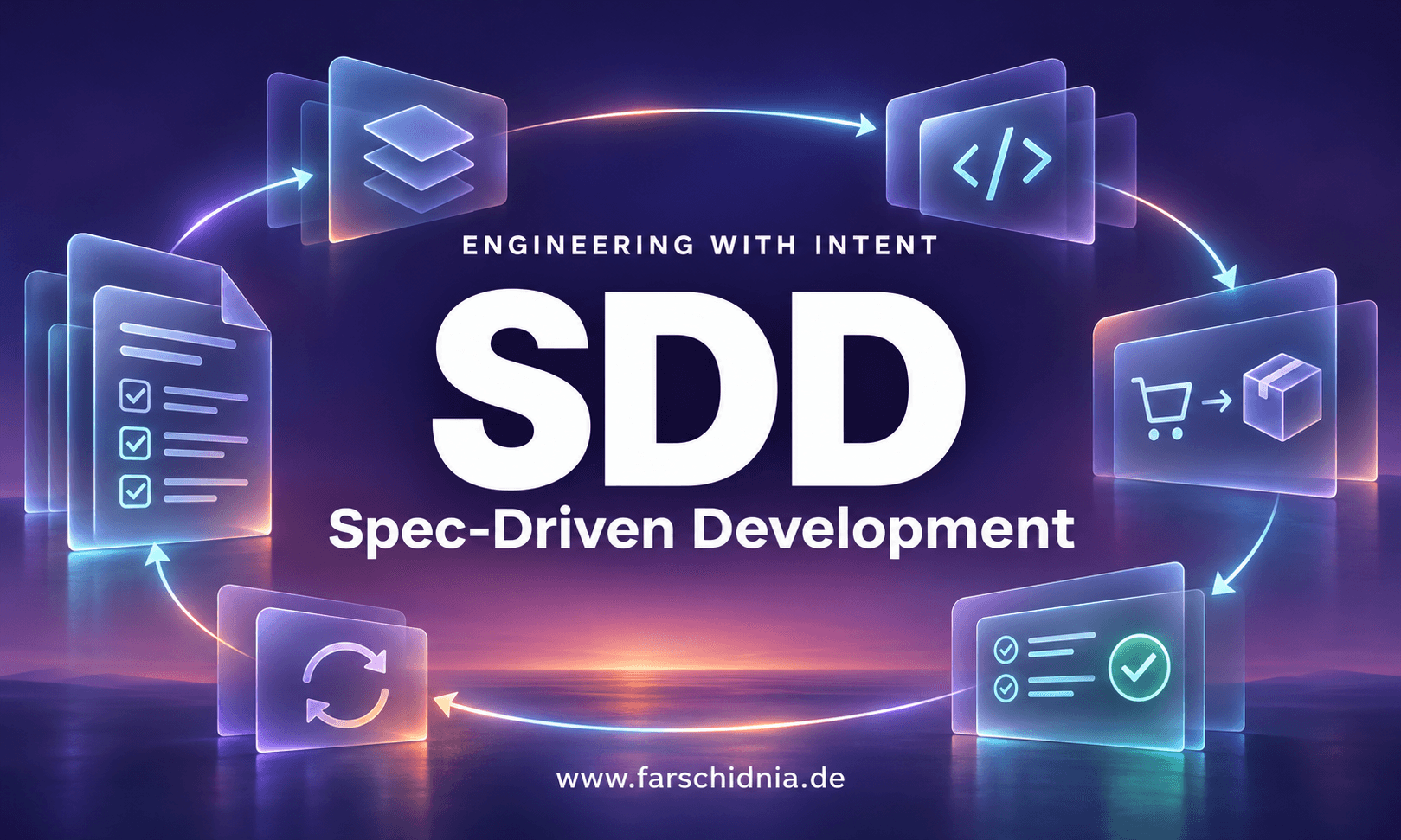
Spec-Driven Development, commonly called SDD, provides a structured way to address this problem. It uses explicit specifications to guide implementation and establish how the result will be evaluated.
What Is Spec-Driven Development?
Spec-Driven Development is an approach in which a specification guides the creation and verification of software.
A specification describes the intended behavior of a system or feature. It explains what users should be able to do, which rules apply, what constraints must be respected, and what counts as a successful result.
The specification becomes a shared reference for developers, testers, product owners, and AI coding tools. Instead of relying on scattered conversations, the team works from an agreed description.
There is no single universal SDD process. Some teams use short feature documents. Others use structured requirements, interface contracts, and detailed acceptance scenarios. The essential principle is consistent: important development decisions should be traceable to explicit intent.
Why SDD Matters
Many software defects begin as misunderstandings.
A developer may implement a requirement correctly according to one interpretation, while the product owner expects something different. A tester may discover an edge case that nobody discussed. Two services may use different assumptions about the same data.
SDD makes these differences easier to identify before they become deeply embedded in the system.
Writing a specification requires the team to examine its own expectations. Words such as “fast,” “secure,” and “user-friendly” need more precise meaning. A feature boundary needs to be clear. Failure conditions need to be considered.